


Accessibility Information
Stockton University is committed to providing equal access to our programs and facilities for persons with disabilities.
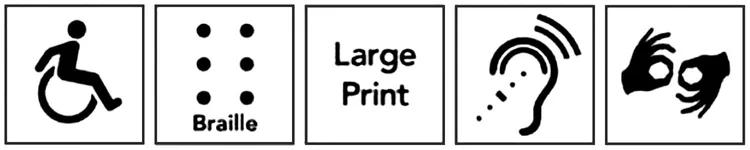
See information about:
- Noyes Arts Garage
- Advance Notification Policy
- Accessibility Statement
- ADA Grievance Procedure
- Patron Grievance Policy
- Service Animal Procedure
- Stockton University Statement on Diversity, Equity & Inclusion
Noyes Arts Garage
Murphy Writing’s office for planning programming is at the Noyes Arts Garage.
Wheelchair accessibility:
- There are exterior ramps leading to the Garage’s main entrance on Mississippi Ave and Fairmount Ave. See this space in 3D.
- Inside of the parking garage there is a ramp to the right of the incoming gate on the Fairmount Ave entrance that leads to the Blue door entrance of the Noyes space. See this space in 3D. All restrooms are wheelchair accessible. Restrooms are located near the Blue door entrance.
Individuals who are blind or have low vision: The gallery guide is available in large print in each of the galleries. Braille is available by request two weeks in advance. Please contact Michael Cagno at michael.cagno@stockton.edu or by calling 609-626-3805 to make a request for these accommodations.
Individuals who are deaf or hard of hearing: Automated captioning will be available soon for online programs. American Sign Language (ASL) interpretation and live captioning is available for public programs upon request with two weeks advance notice. Please contact Michael Cagno at michael.cagno@stockton.edu or by calling 609-626-3805 to make a request for these accommodations.
Advance Notification Policy
If you require accommodation or service (i.e., ASL, Open Captioning, Audio Description, etc.), please contact Michael Cagno at 609-626-3420 or michael.cagno@stockton.edu at least two weeks before your event.
Accessibility Statement
Murphy Writing of Stockton University is fully committed to providing equal access for its patrons, employees, students/faculty/staff, and the public. Upon request, Murphy Writing of Stockton University will make the necessary accommodations to allow individuals with special needs to participate in Murphy Writing of Stockton University services, programs, and activities to the fullest extent possible. Murphy Writing of Stockton University has a designated coordinator to facilitate compliance with the Americans with Disabilities Act of 1990 (ADA), as required by Section 35.107 of the U.S. Department of Justice regulations, and to coordinate compliance with Sections 504 and 508 of the Rehabilitation Act of 1973. The coordinator is a liaison between the University and the Museum. While the above laws mandate equal access to people with disabilities, Murphy Writing of Stockton University prioritizes establishing a workplace and environment that embraces the spirit of the law, ensuring an optimal experience for all. Information and other accessible materials will be made available on our website promptly, and upon request, information will be made physically available in alternative formats. Murphy Writing of Stockton University and the University regularly review its policies and procedures to adapt, accommodate, and address any issues that might arise regarding ADA compliance and will periodically assess its progress.
ADA Grievance Procedure
This procedure is meant to provide an internal mechanism for Murphy Writing of Stockton University to be used in the event of a complaint received from its public regarding accessibility. This procedure will also ensure commentary about the organization’s policies concerning ADA compliance. Every effort will be made to satisfy the complainant at the earliest stages of interaction, based upon the organization’s increasing capacity to provide complete physical and programmatic access.
Information Gathering
The Access Liaison will communicate with the complainant to determine the nature of the complaint and create an open dialogue with the complainant. Depending upon the location of the complaint, other staff may be involved in this initial process. This exchange aims to address the complainant’s need as quickly and positively as possible, within the scope of the organization’s ability to meet that need, and to use that information to assess future needs determinations. The Access Liaison will document all information received.
Complainant Unsatisfied
Following the Initial Interview, if the client is not satisfied with the initial information-gathering process/interview, the Access Liaison will encourage the complainant to participate in additional mediation, which would include the particular Murphy Writing of Stockton University’s Executive Director of the location where the complaint occurred.
Suppose the client is not satisfied by the above additional mediation. In that case, the Access Liaison will assist the client in preparing a written description of the problem, which will be presented for review to the organization’s ADA 504 Act Steering Committee.
This complaint must include:
- Name, Address, and telephone number of the complainant
- A detailed description of the complaint, including date and time Location of access barrier
- Client’s recommendation for resolution
- Written Complaint
The Access Liaison will assure the complainant that the ADA 504 Act Steering Committee’s review ensures that a solution is devised to meet the client’s needs to the best of its ability. This will be done within established programs and facilities, and the committee will consider installing new policies, programs, and facility improvements to ensure this success.
Reviews of Written Complaint
A review of the complaint will take place within 30 (thirty) days after receipt of the written complaint. The committee will consider:
- Is the complaint valid?
- Was access denied?
- What were the circumstances of the denied access?
- Is this a standard or unusual condition?
- Was lack of access a result of policy, and if so, is a new policy warranted?
- What must happen to access?
- Are there possible alternatives?
- Are there any mitigating factors that would limit the resolution of the problem?
- What is to be done to ensure success in the future?
- Will the solution demand funding?
- If so, how will it be funded, and on what timeline?
- What follow-up should be done with the complainant, and by whom?
The complainant must be assured that the committee’s recommendations will be presented to the ADA 504 Act Steering Committee. The complainant must sign the recommendation(s) as acceptable to him/her, agreeing that if the recommendation is followed, the matter is closed.
Resolution of Complaint
At the next appropriate Board of Trustees meeting, the recommendations of the ADA 504 Act Steering Committee for resolution are presented, and a decision is made based upon that recommendation to allocate existing funds and resources and/or to include the recommendations as part of ongoing resource development. The Access Liaison then notifies all staff of the nature of the grievance and its resolution. The recommended solution is implemented.
Adopted: 10/4/22
Patron Grievance Policy
Purpose: The Patron Grievance Policy addresses patron complaints regarding museum services, procedures, policies, and staff conduct. Museum policies and procedures have been developed to provide fair and equitable service to all individuals. Persons who have experienced difficulties with a museum service, policy, or staff member are encouraged to discuss those concerns with museum executive director. The executive director will attempt to resolve issues as quickly and fairly as possible; however, a patron may request to file a formal grievance using the procedure as follows if the issue cannot be resolved.
Patron Grievance Procedure
- A patron who wishes to file a formal grievance about a museum policy, procedure, service, or staff member’s conduct may submit a written complaint to the Executive Director.
- The written complaint should include: the date of the complaint/incident, the name and contact information of the individual making the complaint, and a detailed explanation of the issue.
- Written complaints sent to the Executive Director will be reported to the Noyes Advisory Board, and the Dean of Arts and Humanities.
- The patron will be informed of the decision and what action was taken regarding the incident.
- The decision of the Advisory Board and Dean with respect to a complaint will be final.
- Intentionally bypassing or disregarding this procedure will result in an immediate dismissal of the complaint.
Effective date: 5/12/22

